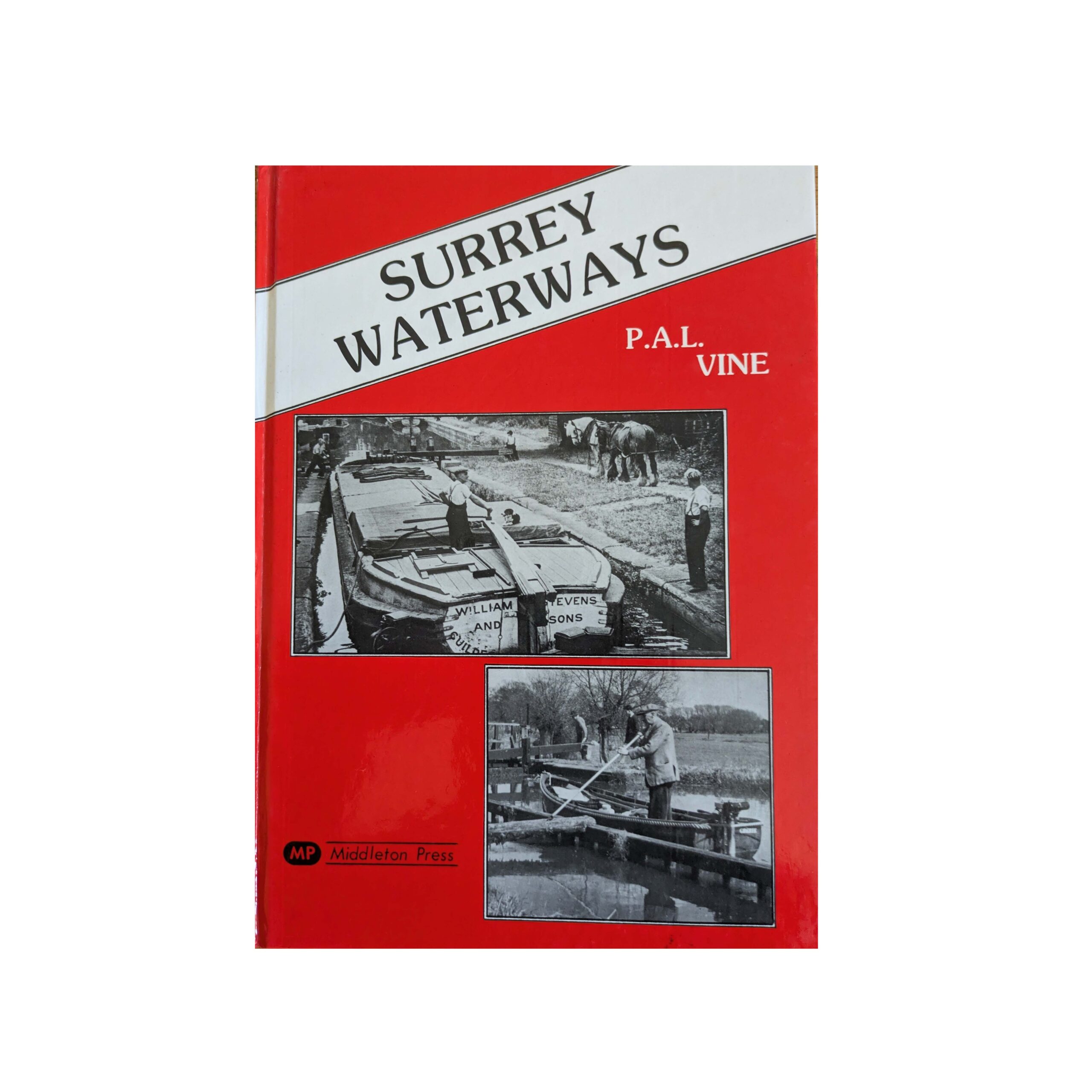
Surrey Waterways
£9.95
This book is out of print. The copies available are second hand, in near-as-new or very good condition.
The story of Surrey’s local waterways from the days of their commercial importance, through the period of total abandonment into the present age of slow revival is told authoritatively by Paul vine, author of the classic London’s lost route to the Sea. The reader also benefits from over 120 of his unrivalled collection of photographs, prints and maps relating to this unique chapter in our local history.
Only 1 left in stock
Although the Thames forms the northern border of Surrey, this book concentrates on the county’s waterways that were made navigable. Its rivers are all tributaries of the Thames but only the Wey was artificially improved. In spite of many proposals for new waterways during the canal era, only four were in fact built. (1) The Basingstoke canal of whose course little more than 1/3 is in Surrey but in which county lie 28 of the waterways 29 locks. (2) The Grand Surrey Canal which was planned to reach reach Mitcham from Rotherhithe, but which in fact only went as far as Camberwell. (3) The Croydon Canal, which was built from the Grand Surrey Canal to Forest Hill, Selhurst and Croydon and which was in competition with the Surrey Iron Railway for 25 years. Lastly in point of time came (4) the Wey and Arun Junction Canal, which ran 9 miles to the South of Shalford before crossing into Sussex en route for the Arun valley and the English Channel.
Besides the Grand Imperial Ship Canal, projected from London to Portsmouth in 1824, various canals were planned between the Thames and the English Channel, and which are described in London’s lost route to the Sea. Just as the Surrey Iron Railway was the world’s first public railway, so the Croydon Canal was the first waterway to be taken over by a railway when it closed in 1836.
The Wey Navigation, whose commercial utility lasted over a period of 300 years, was the most profitable of the Surrey waterways and played an important role in the development of trade to Guildford and Godalming. Its busiest period was in the 1830s when an average annual tonnage of 68,000 was carried compared with 25,000 on the Basingstoke Canal and 18,000 on the Wey and Arun Junction Canal. A century later, between 1930 and 1936, 51,000 tonnes was still being carried annually. Railway competition caused the Wey and Arun to close in 1871 but the Basingstoke remained in commercial use until 1949, the Godalming Navigation until 1950, and the Wey Navigation until July 1969. The Wandsworth Canal ceased to be used about 1920 and the Grand Surrey Canal was closed with the abandonment of the Surrey Docks in 1971.
Author: P A L Vine
Binding: Hardback
Published: November 1987
Pages: 96
Size: 240 x 172 mm
ISBN: 0906520517
Publisher’s Price (in 1987): £7.95