Kent and East Sussex Waterways
£9.95
This book is out of print. The copies available are second hand, in near-as-new or very good condition.
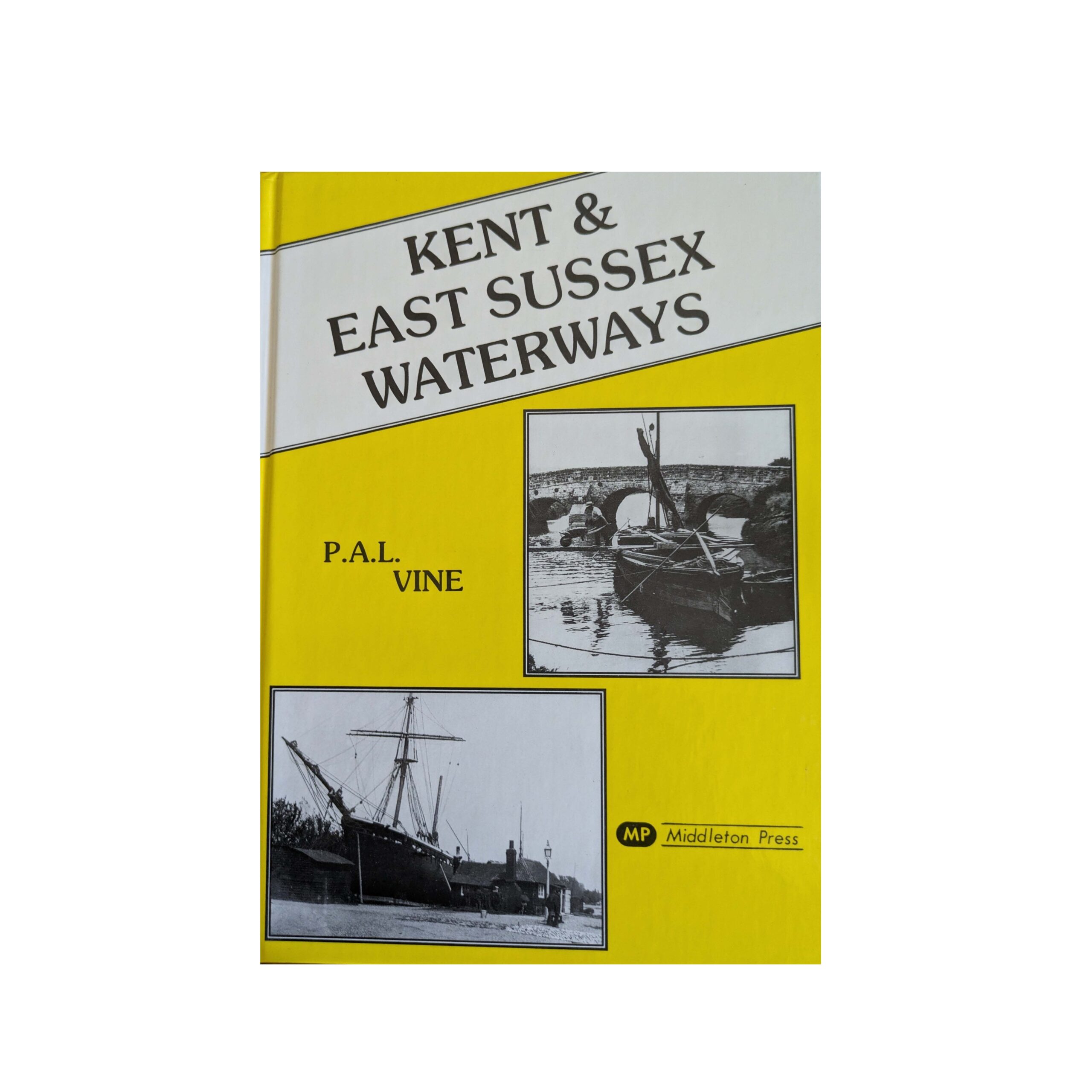
The story of Kent and East Sussex’s waterways, from the days of their commercial importance through the period of total abandonment, to the present age of slow revival, is told authoritatively by Paul Vine, author of the classic London’s lost route to the Sea. The reader also benefits from his unrivalled collection of photographs prints and maps, of which 121 are included in the book.
Only 1 left in stock
For centuries, the Thames and the Port of London formed the vital artery of Britain’s commerce. The Thames was never made navigable, for it has always been so, although above its tidal reaches, boats were much impeded by fish dams and mill weirs into which were incorporated flash locks. Not however, until 1635 was the river considered navigable for barges as far as Oxford.
Although the Thames forms the northern boundary of Kent, this book concentrates on the county’s waterways that were made navigable, or which were used by barges on their tidal reaches. By far the most important was the river Medway whose commercial utility spans three centuries and played an important role in the development of trade to Maidstone and Tunbridge. However, many of the smaller Kent and Sussex rivers were of considerable utility during the 19th century in providing outlets for timber and agricultural produce, while enabling coal and manufactured goods to be imported.
In spite of many proposals for the new waterways during the era, only three were constructed. Two of these were built by the government during the Napoleonic wars – the Royal Arsenal Canal at Woolwich, which was began in 1812 and completed in 1817, and the Royal Military Canal, which was dug 22 miles around Romney Marsh during the Napoleonic wars, to hinder an invasion force making a landing along the flat part of the Kent coast between Shorncliffe and Winchelsea. The third, and the only canal intended for commerce, was the Thames and Medway Canal, whose short existence between 1824 to 1845 was terminated by its purchase and partial closure by the Gravesend and Rochester Railway Company.
There were two great canal projects which never came to fruition. The first was John Rennie’s Grand Southern Canal, which was planned to run from the Medway at Tonbridge to Portsmouth. Its 95-mile line would have passed through Edenbridge, Horsham and Pulborough, with branches to the Adur, Ouse, Croydon Canal, and the Weald of Kent Canal. Its bill was considered in Parliament, but lost on second reading in 1810. The second was the Weald of Kent Canal, which was planned from the river Medway at Brandbridges to the Royal Military Canal at Appledore, a distance of 30 miles and 24 locks. Its Act of Parliament obtained in 1812, with an authorised the capital of £305,800, which had to be raised within three years before work could start. By 1815 only £103,900 had been subscribed and the attempt was dropped.
Author: P A L Vine
Binding: Hardback
Published: October 1989
Pages: 96
Size: 240 x 172 mm
ISBN: 090652072X
Publisher’s Price (in 1990): £7.95