The walks were founded by IWA member and London-based medical doctor Michael Essex-Lopresti. Fifty years on, the walks are in their 50th season, there have been nearly 1,300 walks, over 19,000 customers, and over £70,000 has been raised for IWA.
Michael and his wife had joined a ‘Regent’s Canal Walk’ in 1975. The guide was expert on London but knew little about the canal. When at Hampstead Road Top Lock, Michael commented that from the lock there was 27 miles of level canal without any locks. The guide looked surprised and said “Does it go on that far? I thought it was built by Nash as a decorative feature for his Regent’s Park”. Michael wrote to the company offering some notes on the story of the canal and its relationship to the national network, but he was told that the walk was not proving popular and the company was giving it up. He then suggested that IWA that they should pick up the walks. IWA management at the time deliberated on the idea and eventually agreed – and told Michael that he was designated to run the walks. He invited volunteers at an IWA meeting in 1976 and Brian Hague and Len House joined him.
Brian and Michael decided that the walks should start and end at a tube station and last about 2 hours. They explored possible routes from and to suitable stations and researched the walks and the history of the canalside buildings and other features. The aim was to introduce people to the waterways at no expense to IWA, so walkers were asked to make a 30p donation to IWA to cover cost of the printing and distribution of leaflets. The guides would not receive any fee or expenses. Every walker should receive a leaflet with story of canal and an IWA membership application and discussions would be held with London Tourist Board to ensure that there would be no conflict with official guided walks in London.
The walks were launched with two on Sunday afternoons and two Tuesday evenings. Fliers and posters were printed by WRG and distributed to all public Libraries in London, press and radio stations, waterways magazines, etc. Walkers met at the quiet tube station at Camden Town and went to Paddington or Islington. A newspaper vendor there would often remark when it was pelting with rain “Nobody will turn up today” and he even rashly suggested that if no-one came he would go on the walk himself; he boasted that he had never had to do so! The walks continued to start only at Camden until 1993 when walks to Mile End, Limehouse, the Bow Back Rivers, the New River and Paddington Basin were added.
The walks turned out to be far bigger than expected, so on Summer Sunday afternoons two guides attended; in September 1977, 118 people turned up! Over the years takings have far exceeded the cost of printing and publicity and Michael was awarded the John Heap Salver in 1988 and again in 1999 by IWA and was appointed vice-President of IWA’s London Region.
On one of Michael’s walks in 1992 only four people attended. One of them subsequently revealed himself as David Tucker, who ran London Walks, who was checking on the quality of IWA’s guides and he generously invited a partnership. This was discussed and happily agreed; this saved IWA the cost and effort of printing and distributing posters and gave much wider publicity at no extra cost.
By 2006, Roger Wilkinson, then chair of IWA North & East London Branch, reported that over 11,000 walkers had been introduced to the canals on 656 walks. Although initially the walks were intended to cover their costs at no expense to the IWA, in fact within the first 30 years they had raised over £22,000 for IWA and there were six guides leading walks on a rota.
Since 2006, IWA Towpath Walks has launched a succession of new walk routes, which now include many places on canals and rivers in the London area – such as the Grosvenor Canal. There are now 28 different routes on offer. As one of the objectives of starting these walks was to popularise the towpath as a place to walk, it is gratifying that 15 million people now visit London’s canals every year.
The Pandemic had a drastic effect on everyone. Nevertheless, while carefully complying with the rules, it was possible to guide walks in parts of both 2020 and 2021.
The money raised on these IWA Towpath Walks is all distributed to IWA branches in the London Region. They have chosen to donate some of it to waterway-related projects in the London area, such as Pirate Castle and Carpenters Road Lock restoration. They have also distributed some to waterway projects across the country, such as those of the Wey and Arun Canal Trust.
Other IWA branches have taken up the idea too, and there are regular walks offered by IWA Chester & Merseyside Branch, IWA Lichfield Branch and IWA Lancs & Cumbria Branch.
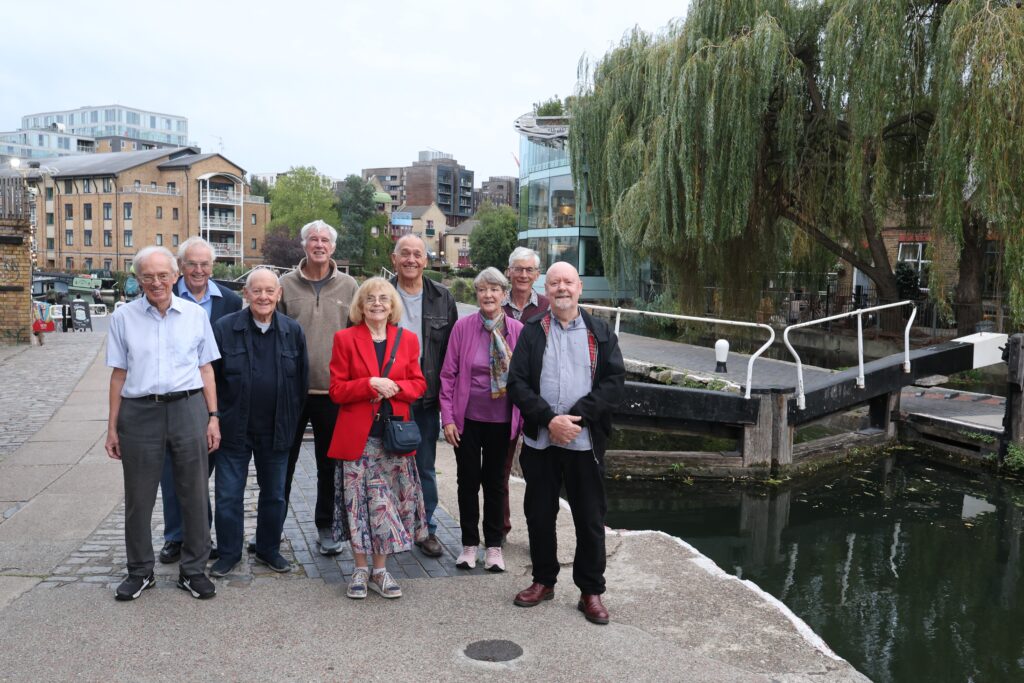
The photo above, from the gathering to mark the 50th season of IWA Towpath Walks shows:
Back row (left to right): Paul Strudwick (IWA London Region Chair); Chris Foster (guide); David Tucker (London Walks); Charlie Forman (guide: one of the three officers of IWA Towpath Walks).
Front row(left to right): Roger Wilkinson(guide: Chair of IWA Towpath Walks); Mike Gee (Treasurer of IWA Towpath Walks); Mary Tucker (London Walks); Lesley Thompson (guide); Alan Byrne (guide).
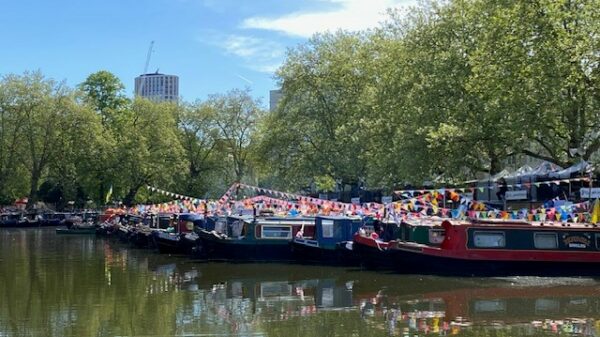
[The top photo shows at atmospheric shot of the Regent’s Canal near King’s Cross – a frequent venue for the towpath walks – by Nigel Essery]