In order to make IWA’s navigation-related campaigning work more visible, a Navigation section will be included in future editions of the Bulletin email alongside the Restoration and Environment sections.
- Water resources
The Sustainability & Environment Group now leads in the area of water resources for IWA, but there are many aspects relevant to navigation.
- Water Abstraction
Navigation Committee has been aware for some time of the view expressed by CRT Chief Executive Campbell Robb that the forthcoming renewal of CRT’s abstraction licences issued by the Environment Agency (EA) represents the single biggest threat to the canal network. The reason for this is partly the effort and cost required to renew them, but primarily the potential risk to water supplies from onerous conditions being imposed such as reduced abstraction or the requirement for fish screening. The latter has emerged as a live issue, firstly on the Monmouthshire, Brecon & Abergavenny Canals where feeds from rivers and streams have been taken out of use in preference to the installation and maintenance of very fine screens. More recently, restricted opening hours have been imposed at Diglis Locks at the junction of the Worcester & Birmingham Canal with the River Severn, because of restrictions on the use of back-pumping without fish screening being implemented. CRT’s Head of Boating and Customer Service described this in Navigation Committee’s recent meeting as a very concerning situation which will be replicated elsewhere across the network and will impose millions of pounds of extra cost on CRT – costs which were of course not foreseen when CRT was established as a charity.
It has become apparent through these events and through consultation documents that EA appears to be protecting river environments over other aquatic environments such as canals in water abstraction, despite canals being long-standing legitimate and necessary abstractors of water which provide environmental benefits in their own right. This point was raised in Navigation Committee’s recent liaison meeting with Defra’s inland waterways team, who were sympathetic to the view and said they had been in discussion with CRT for several years. It appears that there may be an important role for IWA in pressing CRT’s case that canal water supplies need to be protected. The point was explicitly included in IWA’s response to the latest EA consultation, the Consultation on Significant Water Management Issues, which was submitted on 18th May.
- Water Retention
A draft document setting out IWA’s proposals for improving the security of water supply for navigation on CRT’s canal system had been discussed at the last Navigation Committee meeting and the content agreed. The format was subsequently developed and the document sent to the CRT National Boating Manager with a formal response for feedback from the National Hydrology Manager and the Operations Performance Director.
- Water Transfer
Navigation Committee noted that IWA’s response to the Grand Union Canal Transfer Phase Two Public Consultation had been led by Graham Heald and submitted on 30th March and a news item had been published. IWA called for a more comprehensive and transparent demonstration of the engineering of the canal section of the scheme to show how the water flows would be managed and controlled, both to ensure navigation within the transfer length and to maintain or preferably enhance water supplies to the wider canal network to London, Oxford, Northampton, Warwick, Leicester and Shardlow. IWA Northampton Branch also submitted a response focusing particularly on local points.
- CRT work on Water Resources
The CRT Council Boater Representatives group had a special meeting on water resources on 20th April, attended by Sue O’Hare as IWA nominee on Council and Graham Heald by invitation.
A report was provided on CRT’s incident review of the 2025 drought. It had been found that knowledge transfer and collaboration across the organisation had worked well, together with strong leadership roles. Areas for improvement included asset reliability, data and water level and flow measuring (SCADA) limitations, and communications (where it had proved challenging to achieve the right balance between certainty and comprehensiveness). A positive outcome had been the addition of new roles in the National Hydrology team. A webpage of drought FAQs has been produced.
In terms of the outlook for 2026, the wet winter had helped to replenish reservoirs but it had been followed by a dry spring. The position of reservoir work had improved over last year with some works being finished, meaning that Toddbrook Reservoir could be refilled and brought back into use and capacity restrictions on some other reservoirs lifted.
A revised Water Resources Strategy was already overdue and still in preparation, with CRT seeking clarity from EA over the Water Resources National Framework which imposes new and unique expectations on CRT.
- Condition of the waterways
The two major breaches (the Llangollen Canal at Whitchurch and the Bridgewater Canal at Little Bollington) continue to cause disruption for both businesses and individual boaters. CRT appears to be making rapid progress at Whitchurch, but despite repeated assurances that the Bridgewater Canal Company still intends to reopen its canal by the end of 2026 there is still no visible work being carried out yet. More positive news was the reopening of the Staffordshire & Worcestershire Canal ahead of schedule after the repair of the collapsed bywash at Penkridge.
Other issues discussed around the network included the lack of announcements about repairs to the Anderton Boat Lift, the water level problems at New Islington Marina in Manchester, the ongoing closure of the Tame Valley Canal at Spouthouse Embankment, the problems at Keadby Lock and the Vazon sliding rail bridge on the Stainforth & Keadby Canal, the deteriorating condition of locks on the Bridgwater & Taunton Canal, the closure of the Avon Navigation for the rebuilding of Nafford Lock, the reopening of Baits Bite Lock on the River Cam and Salter’s Lode Lock on the Middle Level Navigations following work on the guillotine gates.
It is very noticeable that CRT is now talking of difficult conversations about less well-used waterways, such as the Dee Branch which it has said is effectively permanently closed. Developments elsewhere are equally concerning. The Great Ouse Boating Association views the decline in the condition of EA assets on the Great Ouse as having reached a critical point and will be highlighting this to politicians in its joint campaign cruise with Fund Britain’s Waterways in July. The Basingstoke Canal has recently lost its manager and the position will not be filled.
- Closure of CRT Customer Service Facilities (CSFs)
Following a consultation with boaters in 2022 on the minimum standard for CSFs, CRT announced that showers, toilets and laundry facilities would be closed across the network from November 2025 and invited expressions of interest from other organisations in running them. Navigation Committee was concerned at the time that the closures appeared rushed and it was unclear that the published process had been followed, and requested that CRT answer a set of questions. Since then, there has been widespread dissatisfaction and discussion on social media, and Navigation Committee received a specific enquiry highlighting the impact in areas where many boaters have small cruisers in which it is impossible to install usable facilities. A response from CRT was still awaited but a specific commitment was made in the recent Navigation Committee meeting with the National Boating Team.
OTHER POINTS
- CRT’s Independent Commission on the Future of Boat Licensing
As previously reported, a small subgroup of Navigation Committee is taking thoughts forward so that IWA is ready to respond to further consultations at the appropriate time. CRT has recently appointed a Boating Transformation Programme Manager, Alice Hamilton. Alice will lead the work on communications and engagement. The plan is for a pre-consultation with national boating organisations followed by a 3-month consultation over summer, during which CRT is hoping for face-to-face contact with boaters as well as online.
- Residential boating/mooring
The All Party Parliamentary Group for the Waterways meeting on 14th April explored residential boating, with presentations by the Residential Boat Owners Association and the National Bargee Travellers Association. The complexity of the subject has since been highlighted in mainstream media after it became known that the Leader of the Green Party, Zack Polanski, may not have paid Council Tax that was due.
- Fishing matches and visitor moorings
A CRT stoppage notice recently stated that a fishing match was to be held right across the visitor moorings on the Trent & Mersey Canal in Rugeley, which are intensively used by boaters to visit the town centre shops. The issue was resolved following contact by Helen Whitehouse with the CRT West Midlands Regional Director, but the general principle was raised by Navigation Committee in its meeting with the National Boating Team. CRT confirmed that the principle agreed by British Waterways of not allowing fishing matches to be held over designated visitor moorings still stands, and that the stoppage notice in question had used the wrong template and given an unintended message.
- Boat Safety Scheme consultation on Smoke Alarms
IWA’s response to the BSS’s consultation was submitted on 22nd April, in support of introducing a new mandatory safety standard for the correct number of suitable working smoke alarm(s) in good condition.
- Skippers Guide to Trent Falls
The Skippers Guide to the Passage Planning and Transit of Trent Falls produced by Brian Sharples and endorsed by Navigation Committee has been published here.
- Decarbonisation of the Inland Waterways
Navigation Committee noted the adoption of the Sustainable Boating Group Policy for the Decarbonisation of the UK Inland Waterways Leisure Fleet by trustees as an IWA policy. It has been submitted to the Department for Transport as part of their Call for Evidence on the Decarbonisation of Smaller Vessels.
- Environment Agency National Waterways Forum and National Waterways Advisory Group meeting 25th March (attended by Sue O’Hare as IWA nominee)
The increased focus, importance and funding being given to navigation by EA is good to see, though there is still much to be done. EA’s CEO Philip Duffy has directly committed to improving the navigation service, which has resulted in new posts and transformation programmes as well as increased funding.
- Resource funding £21m for 2026/27 (up from £16m last year and £13m the year before)
- Capital funding £33m for 2026/27 (up from £25m in 2025/26)
- This is the first year of a 3-year settlement, so in principle the same amount of Grant In Aid should be received for each of the next three years, albeit subject to change because of external pressures.
Asset management is the first of the transformation programmes (Project Aurora) including harmonisation of the treatment of assets across EA and development of condition assessments harnessing data and digitisation. EA will be moving to Reliability Centred Maintenance, i.e. inspecting each asset as dictated by its reliability rather than at fixed intervals.
Long-standing work on removing sunken and abandoned boats and on compliance is now coming to fruition. A mooring strategy and a commercial strategy are in development.
A 20-year vision statement has been formally approved: “thriving, valued navigable waterways”. Next will be a 5-year strategy for the management of navigable waterways and associated assets, with four “ambitions”:
- Open, reliable waterways
- More financially sustainable
- Modern, streamlined service
- Adapt and innovate for the future
The next step is the first dedicated director, Simon Hawkins, who will lead the navigation teams, and who started on 1st April (previously, navigation was split across directorates). However this positive news was subsequently tempered by the discovery that the Deputy Director Asset Operations Service, Lindsey Sayner, who has been chairing NWF meetings, has now been seconded to another organisation and the role has been taken over by Mark Ross, who is currently unknown to IWA.
- Navigation Committee six-monthly meeting with Defra inland waterways team – 1st May
As previously noted, the IWA Waterways Directory and the GIS files behind the map had been provided to a new member of the Defra team who is working to understand which waterways are managed by a navigation authority and which are unregulated. The data is being used for exploring access policy and ways of increasing access to unregulated waterways.
The Defra team is still in discussion with CRT about the delivery mechanism for future grant funding and hopes to sign the grant agreement for 2027-2037 before the end of 2026. The additional £6.5m funding which was announced in February was said to have become available internally and was decided to be about the right amount to cover the additional costs because of climate change, hence it was provided as capital investment for dealing with the additional high cost of asset failures.
- Navigation Committee liaison meeting with the CRT National Boating team – 13th May
No further details have yet become available of CRT’s management restructuring beyond the announcements about the CRT top team by Campbell Robb in a video message to volunteers on 23rd April.
Following a request by Navigation Committee, CRT is working on reinstating the total duration of unplanned stoppages as a KPI as well as the number.
The Boater App is in development phase with MySociety and FixMyStreet, and is to be launched this year.
CRT has temporarily taken over control and management of the wharf, facilities and moorings at Sherborne Wharf in Birmingham to ensure that boaters can continue to use them after the bankruptcy of Sherborne Wharf Ltd.
Navigation Committee raised a complaint made about the substantial increase fees for events held on its property, but CRT reiterated that the policy is to cover costs and not to make a profit. Subsidy was no longer affordable.
Forthcoming meetings
- CRT National Boating Organisations meeting – Hatton, 10th June (Roger Stocker to represent IWA)
- EA National Waterways Forum & National Waterways Advisory Group extraordinary meeting on national navigation strategy – 10th June (Sue O’Hare to represent IWA)
- Navigation Committee online meeting – 8th July
Sue O’Hare
Chair of Navigation Committee
25th May 2026
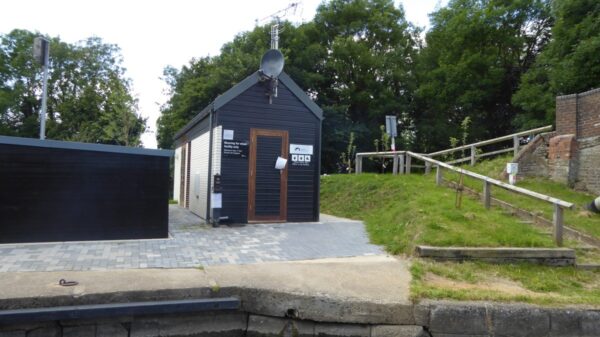
[The photo shows the boaters facilities at Marsworth – by Alison Smedley]
The report from the March 2026 Navigation Committee meeting is available here.
The report from the January 2026 Navigation Committee meeting is available here.
Reports from pre-2026 Navigation Committee meetings are available here.