account arrow-down arrow-left arrow-right closecontact-us emailFacebookheart instagramjoin linkedin phonepinterestplaysearch twitteryoutube

River Weaver

The River Weaver Navigation runs from the Manchester Ship Canal at Weston Marsh Lock and Weston Point Docks to Winsford Bridge and connects to the Trent and Mersey Canal via the Anderton Boat Lift. 

River Weaver Map

Facts & Stats

20 miles

(32km)

The length of the River Weaver that is navigable.

5 locks

+ Swing bridges

There is also a boat lift.

Waterway notes

Maximum boat sizes

  • Length: 196′ (58.8 metres)
  • Beam: 35′ (10.6 metres)
  • Height: 29′ 6″ (8.9 metres)
  • Draught: 9′ 10″ (3.0 metres)

Through boat lift:

  • Length: 72′ (21.6 metres)
  • Beam: 14′ (4.2 metres)
  • Height: 8′ (2.4 metres)
  • Draught: 4′ (1.2 metres)

Navigation authority

Canal & River Trust

Useful Info

  • Locks, swing bridges and Anderton Boat Lift are all operated by Canal & River Trust staff.
  • Navigation above Winsford Bridge and into Winsford Flash is possible, where there is no navigating authority.  The Flash, especially, is very shallow in places and there is a significant risk of boats becoming stuck in the silt.

Development of the Navigation

The River Weaver Navigation was originally developed to transport salt from the Cheshire mines to the port of Liverpool. Its history spans nearly 300 years, evolving from a modest tidal river into a major industrial artery, followed by decline and now modest use for recreation.

Although the River Weaver had been used for centuries to move salt via packhorses and small tidal barges, it was too shallow and winding for larger vessels. In 1721, the River Weaver Navigation Act was passed, authorising the first major improvements to make the river navigable from the Mersey estuary as far as Winsford.  The work was completed in 1732 at a cost of £15,885, involving the construction of eleven timber locks, weirs, and cuts to manage the 50-foot descent to the Mersey over 20 miles.  The original vessels used on the Navigation were known as Weaver Flats, and were either sailed or bow-hauled by men.  The 1732 Act included an unusual clause requiring profits to be used for maintaining Cheshire’s roads and bridges.

The navigation’s fortunes soared with the Cheshire salt trade. The arrival of the Trent and Mersey Canal in 1777 initially threatened river trade, but the two systems quickly became complementary.  By 1793, chutes were built at Anderton to transfer salt directly from canal narrowboats into river barges below, bypassing the need for unloading.  This boosted traffic, with over 171,000 tons of salt moving annually by 1790.

[The photo shows Saltisford Locks, taken in 1939] 
Industrial Expansion and the Anderton Boat Lift

To improve access to the Mersey, the Weston Canal was constructed between 1807 and 1810, linking Frodsham to Weston Point and allowing boats to bypass the then treacherous tidal section of the river.  By the mid-19th century, the Navigation was so profitable that it had paid over £500,000 to Cheshire for road and bridge maintenance.  Between 1870 and 1900, the Navigation underwent a complete reconstruction to accommodate larger seagoing coasters of up to 1,000 tons.  The original eleven locks were replaced by five larger locks, each up to 213 feet long, capable of handling deep-draft vessels.

Anderton Boat Lift opened in 1875.  Designed by Edwin Clark, it was a hydraulic lift that raised and lowered boats 50 feet between the river and the Trent and Mersey Canal, becoming one of Robert Aickman’s Seven Wonders of the Waterways.  The lift revolutionized the transfer of goods, though chutes remained in use for decades. The opening of the Manchester Ship Canal in 1894 further integrated the Weaver into the region’s industrial network, with a new lock at Weston Marsh providing access to the ship canal.

[The photo shows an aerial view of Weston Marsh Lock in 1983 – by John Fletcher]

The Waterway Today

As road and rail transport grew, and the salt industry shifted to pipeline brine pumping, commercial traffic on the Weaver declined sharply after the 1950s. The last major shipbuilding yard, W J Yarwood in Northwich, closed in 1965, having built over 1,000 vessels.  IWA held its National Rally of 1979 at Northwich on the Navigation to campaign for the river, but he Anderton Lift, plagued by corrosion from chemical contamination, was closed four years later in 1983.  During this period, the Navigation’s focus had shifted toward recreation. Efforts began, after much campaigning by IWA and the Trent and Mersey Canal Society, to preserve the historic infrastructure, including the swing bridges and locks, many of which are now Grade II listed.

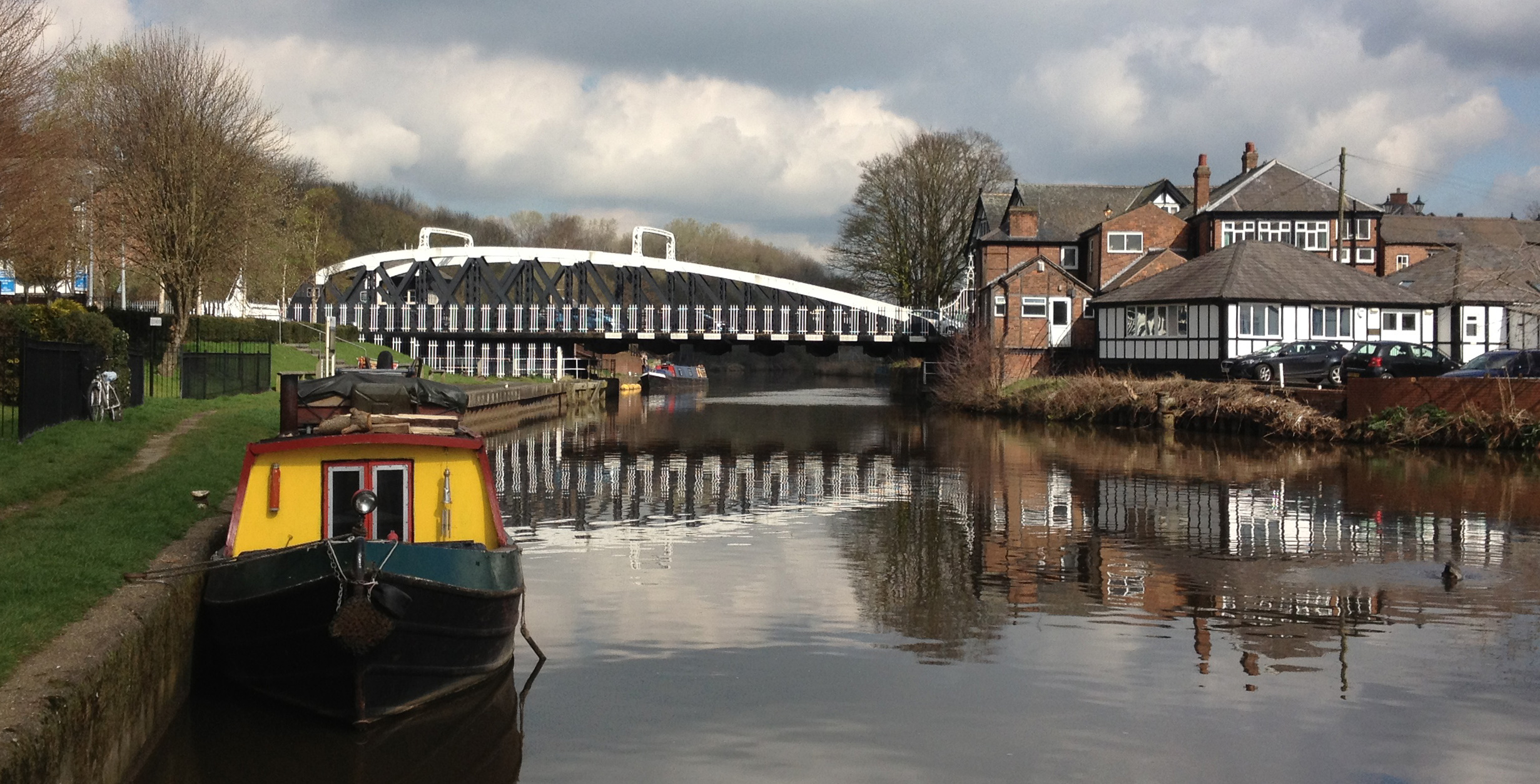
A major restoration project, led by Anderton Boat Lift Trust with IWA support, and managed by British Waterways, reopened Anderton Boat Lift in 2002, replacing the corroded hydraulic system with a modern electric counterbalance design while preserving its historic character.  However, challenges remain. Anderton Boat Lift was closed in January 2025 due to technical issues, sparking campaigns by IWA to secure its reopening and restore full connectivity between the river and canal networks.  The swing bridges have suffered numerous faults, often leaving them out of action for many months and so limiting traffic on the river to those boats with low enough headroom to pass underneath them.  Concerns also persist about the long-term maintenance of infrastructure and the need for dredging to support both commercial and recreational use.

[The photo shows a scene from IWA’s 1979 National Rally at Northwich – by L Pearce]

Waterway news

Waterway underfunding

Hundreds of miles of waterways – along with their unique heritage and habitats – are currently starved of funding and rely on constant lobbying by us to safeguard their future.

Sustainable Boating

We want boating on canals and rivers to be more sustainable and – even though the current overall contribution to UK carbon emissions is very small – we want to help reduce emissions on the waterways.

Waterways Heritage at Risk

Britain’s canals and rivers are a unique, living heritage. But that heritage is at risk – from urban development, lack of protection, loss of skills and knowledge and climate change.

You can help Save Waterways Heritage.

Waterway restoration

Restoring the UK’s blue infrastructure – our inherited network of navigable canals and rivers – is good for people and places.

Local activities